
Ranked Choice Voting is a False Idol
It is not a stepping stone to anything


Explanation of Ranked Choice Voting
Ranked Choice Voting (RCV) is a commonly suggested way of reforming the US electoral system. Rather than choosing just one candidate, voters rank candidates from most to least favorite. The number of first-choice votes each candidate receives is compared, the worst performing candidate is eliminated. Ballots previously assigned to the eliminated candidate are then reassigned to the voter’s next top-choice. This continues until a candidate has a majority.
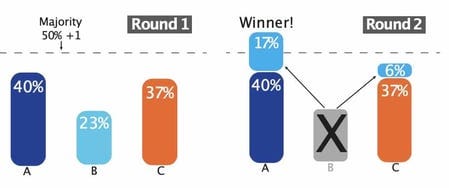
If all the candidates listed on a ballot are eliminated, that ballot becomes “exhausted” and no longer count towards the total. In this way, a majority is always guaranteed by the last round (unless there is an exact tie).
The Appeal of RCV
RCV has some obvious benefits when compared to the typical American system of plurality voting—known as “First Past the Post” (FPTP). Because FPTP only allows voters one choice, they are highly incentivized to select from one of the two candidates they think the most others will also select; a vote for any other is guaranteed to have no impact on who wins.1 In practice, this means almost all voters focus on the two candidates nominated by the major parties.2
In the 2016 American presidential election, the two major parties nominated the most unpopular candidates in history.3 Despite a third4 of voters viewing neither candidate positively, 94.3% still chose either Trump or Clinton. Any other option would have been a “wasted vote.” Perhaps RCV might have let the millions of voters who had reservations about Trump and Clinton express this preference, while still being able to be counted against their most disfavored candidate. This might have changed the outcome, and even if it didn’t, it would have likely felt “more legitimate” to the public.
The 2011 Canadian federal election is another instructive example. Like most wealthy democracies, the primary political conflict in Canadian society is between left and right. Since center-left parties collectively won about 60% of the vote that year (and more votes in 197 out of 308 districts), one might expect the left to have won the ability to govern. Yet, because the left-wing vote was split across four parties (NDP 31%, Liberals 19%, Bloc Québécois 6%, Greens 4%) while the right ran as one party, the Conservatives came first in 55 districts where there was a left-wing majority,5 and thus won a majority of 166 seats with less than 40% of the vote.
The split on the center-left was over identity (with the Bloc wanting a more explicitly binational Canada), environmentalism (with the Greens wanting it prioritized), and tax progressivity (with the Liberals being less ambitious). The fact that center-left voters wanted to register their opinions on these issues does not mean their least favorite opponent should be allowed to rule unilaterally. Yet, that is exactly what happens under FTTP. Under RCV, the argument goes, they would have been allowed to express these preferences while still ultimately contributing to the victory of a non-Conservative in their district. Thus, RCV seems an obvious improvement over FPTP.
When RCV Fails: Alaska & Australia
Alaska
Imagine a three-way race between a left-wing, a center-right, and a hard-right candidate. The left-wing candidate wins only if they do not convince hard-right voters to vote for them. This would be perverse, and it would also be the situation Democrat Mary Peltola found herself in during the 2022 Alaska special election (conducted under RCV).
Peltola’s two Republican opponents were center-right Nick Begich III and hard-right Sarah Palin. One might reasonably have assumed that Begich, since he was the moderate preferred by a majority against every other candidate6 (“Condorcet winner”), should have emerged as the actual winner. In the first round, Begich received 5,800 fewer votes than Palin, and was eliminated. A fifth of his voters had no preference between Peltola and Palin, half preferred Palin, and the rest preferred Peltola. This provided just enough votes for Peltola, who was the first choice of ~40% of the electorate, to squeak out a 51.5% to 48.5% victory against Palin.
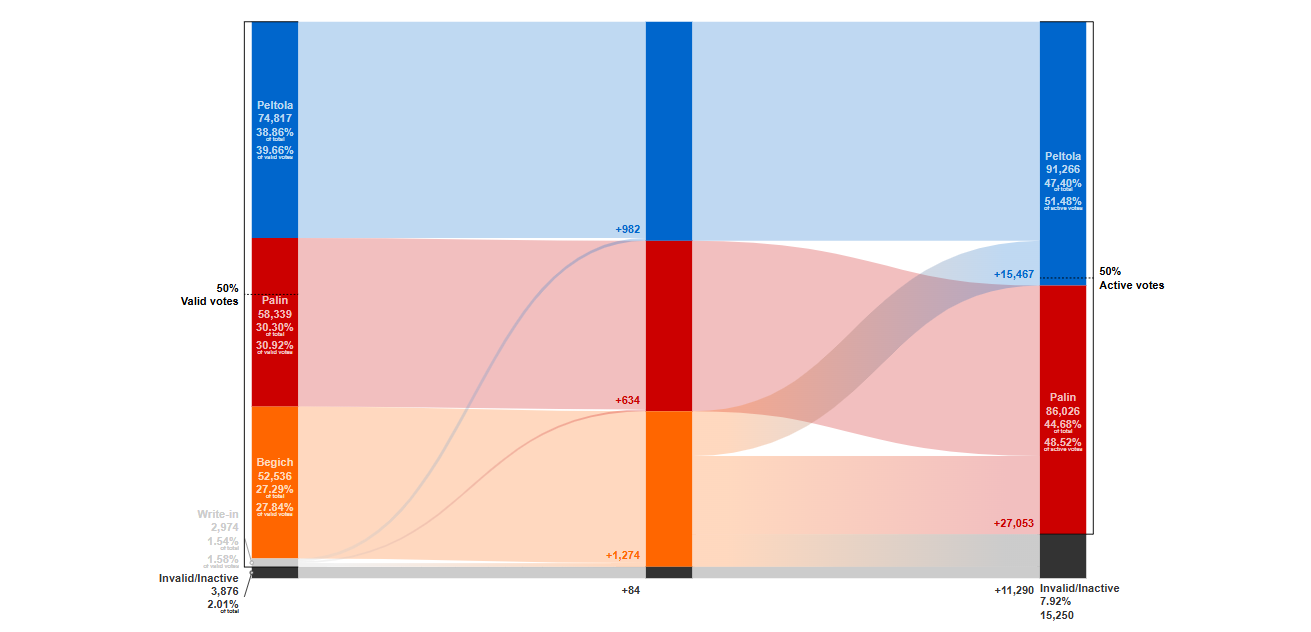
Palin voters do not have a chance to then switch to Begich despite there actually being a majority of people who placed Begich higher than Peltola on the ballot. This is the inverse of the Canadian situation: 60% of votes chose a right-of-center candidate, and yet a left-of-center candidate was elected; this time enabled by RCV.
The incentives around the election are even more pathological than its outcome: Peltola could use her time in the lead-up to the election targeting either Begich supporters or Palin supporters. Given that her final match-up was against Palin, one might think that those are the voters she should prioritize. That is also what we want in a democracy: if you can win over supporters of your most extreme opponent, then you are creating common ground and depolarizing the electorate. But doing so would actually dramatically lower Peltola’s chances to win the election! If 6,000 votes transferred to Peltola from Palin before election day, then Begich, not Palin, makes round two. Then the rest of Palin’s voters would then overwhelmingly support Begich, crushing Peltola in a head-to-head. Not only does this encourage Peltola to refrain from winning over too many Palin voters, but it also encourages her to polarize as many voters between herself and Palin—by, say, running an attack ad which de-emphasizes areas of agreement between Alaskans.
Australia
Similarly perversity is observable during Australia’s last federal election (held under RCV) when one examines Ryan and Griffith. These two Queensland districts held strikingly similar contests in 2025. Both are districts in the inner Brisbane metropolitan area (they actually border each other!). Both have the same three parties competing—the left-wing Greens, the center-left Labor Party, and the right-wing Liberal National Party (LNP)7 In both, the median voter supported Labor and Labor was the Condorcet winner.
Ryan, though, is notably more conservative than Griffith: the left-wing Greens received 2.6pp less first round votes than in Griffith, and the right-wing LNP received 8.9pp more. In Australian political jargon, this means that Griffith has almost twice the “progressive” margin as Ryan. Yet it was Ryan who elected a left-wing Green, while its neighbor Griffith elected a center-left Labor. The strength of the LNP in Ryan (first in the 1st round!) actually caused the Green victory because it prevented their voters from consolidating around the lesser-evil (Labor). In Griffith, by contrast, the LNP’s poorer 1st round showing meant that their voters got to play kingmaker. Since their voters ranked Labor over Greens by a 4:1 ratio,8 Labor beat the Greens.
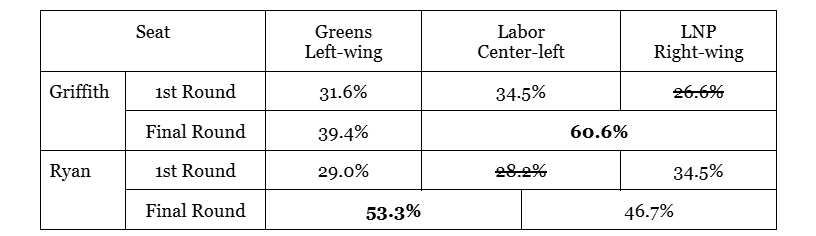
Nationally, the Greens maintained a constant vote share (12.2%) yet lost all of their seats besides Ryan—each of them in more progressive districts. If the LNP had done as badly in Ryan as they had done in Griffith, they would have been eliminated sooner, and thus helped defeat the more radical Greens. The very success of the LNP caused their most hated opponent (dispreferred by LNP voters 4-to-1) to win.
The Mechanisms of RCV’s Failure
RCV is supposed to be a “rationalizing” reform, but the results can be manifestly irrational due several unfortunate features of RCV:
“Non-monotonicity”: A candidate can sometimes win an election in virtue of losing support to their most disliked opponent. (Peltola to Palin, Greens to LNP.)
“Center Squeeze”: A candidate can be the Condorcet winner and still not win if the electorate is sufficiently polarized. (Begich in Alaska, Labor in Ryan.)
“Strategic Voting”: A voter can respond to the above two facts by rationally ranking their ballot not by their actual preferences. This becomes more true the more voters think they are out of line with other voters; yet by voting strategically they conceal what they actually want, depriving others of accurate information about the preferences.
A voter who prefers Peltola to Begich but fears Palin might rationally vote “Begich > Peltola > Palin” to mitigate their most feared outcome, as the early elimination of Begich significantly increases the odds of a Palin win. That same voter, if they are trying to maximize Peltola’s chance of winning, might rationally submit a ballot of “Palin > Peltola > Begich”—despite setting up a second round where their ballot gets used against their most-preferred candidate in favor of their least-preferred candidate—if they think enough Begich voters have Peltola as their next choice that the small boost needed to get Palin above Begich will result in more net-votes to Peltola than simply voting for Peltola.
A popular but supposedly “unelectable” candidate can become genuinely unelectable if enough voters rank “more electable” candidates higher. This can lead to a sense of grievance when “she’s electable if you vote for her” fails to adequately shift perceptions. Supporters can reasonably conclude that they lost not because their candidate lacked appeal, but because a shared belief in her unelectability pushed people to rank others higher—a problem unactionable within the constraints of the formal political process.9
Together, these examples discredit several myths about RCV: it does not reliably select the most moderate candidate; it does not punish polarizing electioneering; and it does not free voters from the need to vote strategically.
RCV is Neither Proportional Nor Responsive
When a party governs poorly, we want it to register a shift in public opinion as a problem needing to be solved. Political leaders are constantly weighing the tradeoffs of short-term expediencies against the long-term benefits of reform. Anti-corruption is one obvious example: the vast majority of party members (both rank-and-file and also leaders) of every party do not enjoy the fact that some of their copartisans are corrupt—yet corruption persists, because the short-term costs associated with ferreting it out feel too large. Electoral loss changes the calculus by simultaneously decreasing access to plums, increasing the saliency of the party’s image, and creating a pretext for action. But this requires a consistent translation of lost support to meaningful costs—i.e., fewer seats and interrupted careers.
Under RCV, shifts in public opinion are capable of causing the legislature to move in the opposite direction. Under RCV, a party might govern poorly, shift the electorate several points against them, and come out with more seats. To understand how dangerous this is, imagine a car accelerating because you slammed the brake, or your body reacting with pleasure because you grabbed a hot pan. Similarly, parties are often deeply affected by factors other than the amount of support they muster—e.g., the Greens losing 75% of their seats on a constant vote share. Given that the purpose of elections is to make parties govern in the interest of the people, RCV’s attenuation of the link between registered opinion and electoral outcome should be disqualifying. All of this is downstream of RCV’s core defect: it is not a form of proportional representation.
It’s worth being clear about what “proportional” means in the phrase “proportional representation” (“PR”). It does not mean “electoral reform” (though it would be a reform in America), and it does not mean “parliamentary government” (which would be a system where Congress could dismiss the president). It denotes the degree to which an electoral system produces a legislature which represents the preferences of society in proportion to their presence in the electorate. Ideally, the legislature would be “an exact portrait of the people at large,” but usually “PR” is applied to a system which has parties represented in close proportion to their share of the vote.
In what sense is RCV not proportional, then? Consider what the legislature would look like if every district is 45% centrist, 35% left-wing, and 20% right-wing. In each district the right-wing gets eliminated, their votes flow to help the center defeat the left. This would result in a 55% non-centrist electorate being represented by an 100% centrist representation. There is no perversity here, or center-squeeze, or non-Condorcet winners. Yet it is still a bad outcome, and one likely to lead to an unresponsive parliament. After all, the left wing percentage could surge ten points or collapse twenty without changing the legislature’s composition.
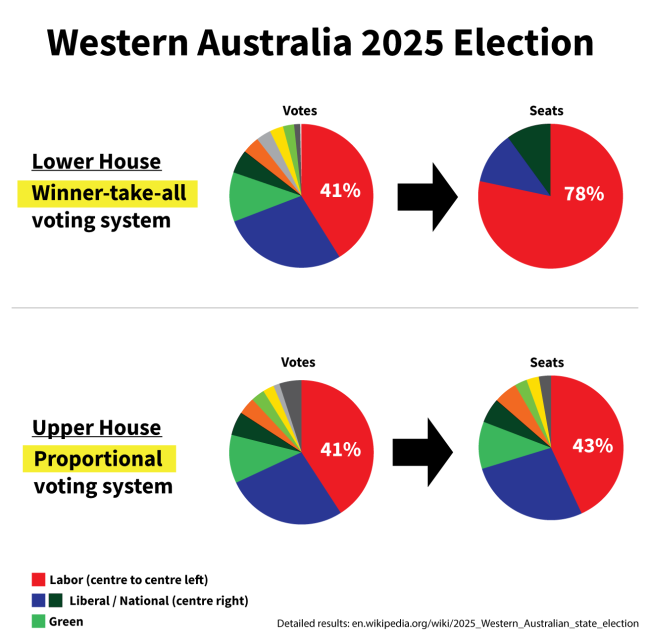

Last year, the state of Western Australia held two parallel elections under two different systems: RCV for the lower house and STV (a form of PR) for the upper house. The electorate, parties, and political context were identical but the outcomes diverged sharply. Under RCV, the 41% who wanted Labor received 78% of the seats, the 33% who wanted Liberals–Nationals received 22%, and the rest (16% to the left of Labor, 9% to the right of Liberals–Nationals) received none. The mechanism for this is clear: in most districts, the smaller left-wing parties were eliminated and their votes transferred to Labor giving them a majority; while, in a small minority of districts, the total number of right-wing voters (42% statewide, but unevenly distributed) outnumbered left-wing voters, and there Liberals–Nationals were always the largest right-wing party, and thus the last eliminated.
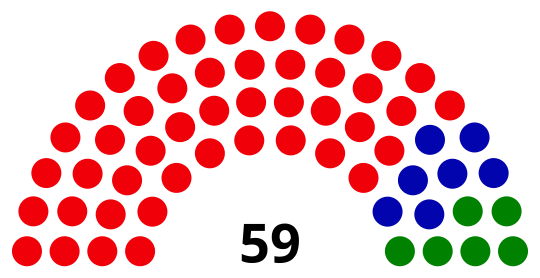
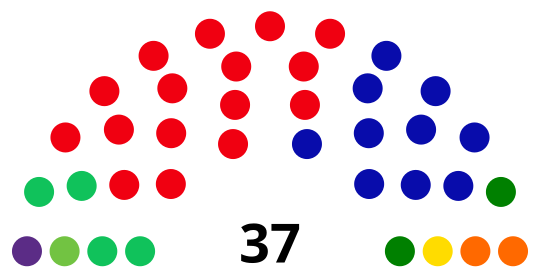
Under PR, by contrast, seven10 parties received representation: Labor (43% of seats), Liberals–Nationals (33%), the left-wing Greens (11%), Legalize Cannabis (2.7%), Animal Justice (2.7%) and right-wing Australian Christians (2.7%) and One Nation (5.4%). In both houses Labor has the largest bloc, leads the government, and holds the central position ideologically (important criteria for shaping policy outcomes), but, besides that, the houses have radically different compositions. The lower house has one-party rule, with even a very large renegade faction being unable to cost Labor its majority. By contrast, the upper house is more representative of the Western Australia’s diversity, better insulated from one-party overreach, and capable of the multi-dimensional negotiation which democracy requires.
Conclusion
The central problem of the American electoral system is that it is unrepresentative and unresponsive. For that to change, we need a system which engenders multiple strong parties, and allocates them seats in proportion to their support. At best, RCV is orthogonal to this: it does not make the system more representative or more responsive.11 Yet, I have seen a shocking number of people casually place “RCV” next to “STV”, “List-PR”, and “MMP” as options to achieve PR. In the 2010s, when both the British Conservatives and Canadian Liberals wanted to punt on a previous nod towards electoral reform, they offered up RCV precisely because it would seem meaningful while not meaningfully increasing competition or requiring them to be more responsive.12
Changing the electoral system is a huge ask, and RCV especially puts an obvious burden on the individual voter. If the public does not see a comparably large benefit, they will subsequently—and rightly!—be disillusioned with “reform” and its advocates. Explaining after the fact that RCV should never have been expected to make the system more representative and responsive will only further undermine our credibility.
While it is easy to say how a vote for the third-place candidate is “wasted”, don’t think too hard about why a vote for the second-place or first-place candidate isn’t—only once has a federal election been decided by one vote. (1910’s NY-36)
I would argue the two major parties are basically “focal points” in a coordination game involving millions of people.
Both Hillary Clinton and Donald Trump were disliked by a majority of the population (52% and 61% respectively). By comparison, Obama and McCain both had 35% unpopularity eight years before, while mid-century candidates routinely ranged from 12% to 22%. Source: https://news.gallup.com/poll/197231/trump-clinton-finish-historically-poor-images.aspx
https://www.monmouth.edu/polling-institute/reports/monmouthpoll_us_082916/
Conservatives achieved absolute majorities in only 108 ridings (35%). They also obtained minority pluralities in 58 others: 27 with 50–45% of the vote, 21 with 45–40%, and 10 with less than 40%. In 55 of these 58 plurality constituencies, the combined vote for the four center-left parties exceeded the Conservative vote (the only exceptions being Saint John, Simcoe—Grey, Edmonton—Sherwood Park).
Based on the limited transfer data released, Begich had a ~53/47 advantage over Peltola if Palin were eliminated first and a ~60/40 advantage against Palin if Peltola had been. http://fairvote.org/press/alaska_cast_vote_record_released/
Confusingly, the Liberal National Party of Queensland is a single party, whereas at the federal level the Liberals and Nationals remain formally separate parties—though they function as a unified bloc. For clarity, I treat them as one entity: “LNP” in Queensland and “Liberals–Nationals” elsewhere.
https://results.aec.gov.au/31496/Website/HouseDivisionPage-31496-163.htm
Note: This is obviously true of FPTP voting too. Hence why I support voting reform and also that voting reform being PR not RCV.
I am continuing to count Liberals–Nationals as one party.
It arguably weakens minor parties (by removing their ability to threaten to “spoil” elections), and it certainly weakens major ones (strengthening candidates vis-a-vis parties).
RCV does do one thing well: it can be invoked after the fact to change the outcome of close or unusual elections. If one is a Democrat mad that Gore lost in 2000, it is easy to imagine that RCV would have changed the outcome. But that election was so close that almost anything could have changed the outcome: a law mandating uniform ballots across Florida, Thurgood Marshall waiting until 1993 to retire, George W. Bush driving off the road in 1976, etc. But for whatever reason, there is a phenomenon of the center-left specifically thinking it would win more with RCV. Setting aside the fact that this is not a good reason to adopt a policy (adding +100,000 votes by statute to every “D” candidate would also increase the number of center-left victories, a policy whose badness I hope is obvious), they are probably biased by being focused on elections they narrowly lost while ignoring those they narrowly won. I doubt they would be any happier in the world where Biden was denied his trifecta because at least 13,500 Shane Hazel voters preferenced David Perdue second in the 2020 Georgia Senate election.